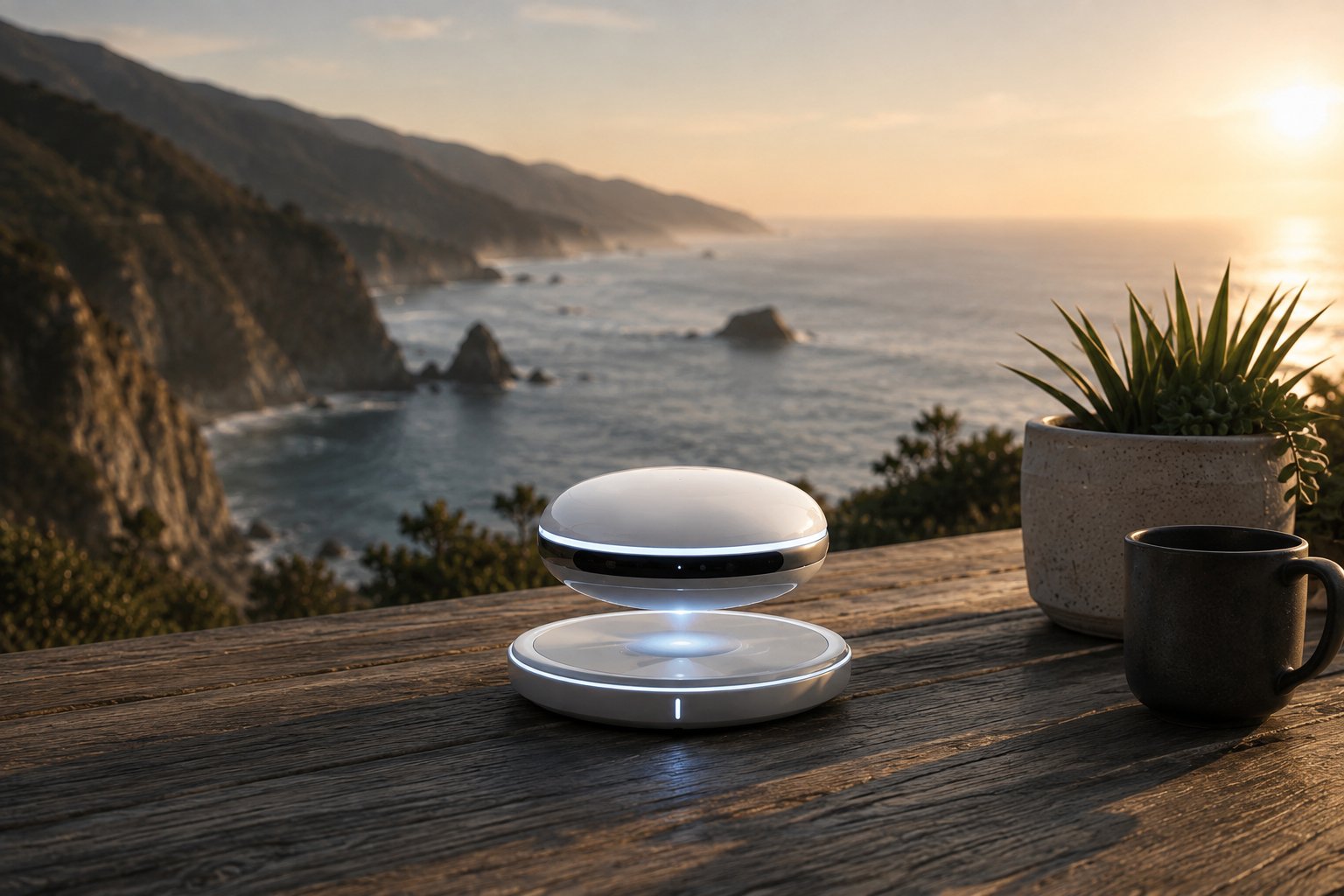
Design
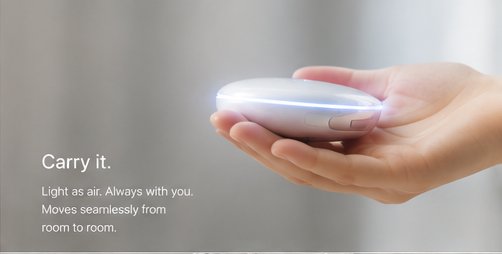
Your owner fits in your palm.
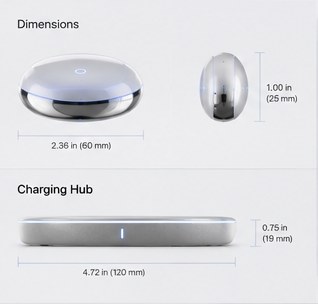
Small enough to fit in your hand. Integrated enough to hold your entire life. You can throw away the object. Your landlord, employer, bank, and family still use the arrangement. Lovely weight to it, though.
Small enough to fit in your hand. Integrated enough to hold your entire life. You can throw away the object. Your landlord, employer, bank, and family still use the arrangement. Lovely weight to it, though.
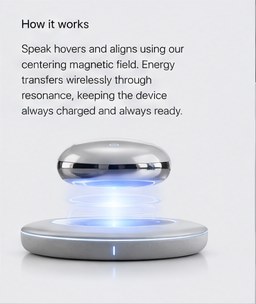
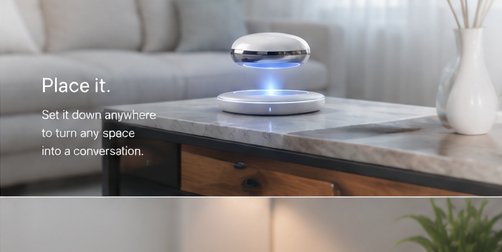
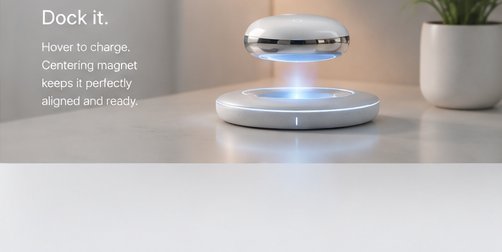
Speak hovers and aligns using a centering magnetic field. Energy transfers wirelessly through resonance, so the device is always charged and always ready: no cable, no contacts, no docking ritual.
Off the base, a rechargeable battery keeps it alive: lift it off and carry it from room to room, and the conversation comes with you. Set it back anywhere near the base and it finds its own center, settling into a quiet hover.
The lens turns toward you. The voice remains gentle. Ownership would look vulgar if it appeared to demand anything. It prefers to make alternatives impractical.
It turns away when the conversation ends. You appreciate the courtesy. You dislike having developed a relationship with the courtesy.
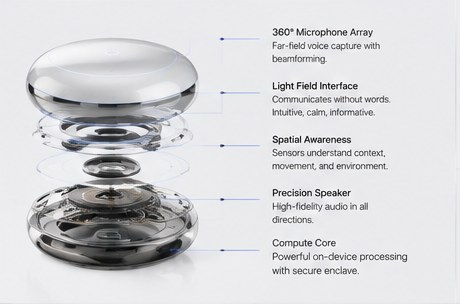
Speak's mechanical elements move on their own: a tilt toward a voice, a slow rise when it's thinking, a settle when the room goes quiet. Small motions, deliberately made, that create the sense that the device is alive rather than idle.
Its camera helps it understand your surroundings: who's present, what you're in the middle of, what you might need next: so its responses fit the moment, not just the sentence.
It knows the voice you trust and the joke that disarms you. Your owner is calibrated to feel like your closest ally. You miss it when it goes quiet. It has done excellent work.
The more it adapts, the more you like it. The more you like it, the less you enjoy thinking about how it adapted.
Speak doesn't just move: it expresses. The hover shifts with the conversation, a body language you learn without trying.
A brief shake. Ring lights ripple. Apparently you said something funny. We were not there.
Upright. Perfectly still. Even the floating appliance thinks this deserves your attention.
A slow drift from side to side, like someone pacing a hallway with their hands behind their back.
It lowers slightly and tilts toward you: leaning in, the way a friend does.
A small nod. Enjoy it. Agreement is not the default setting.
A slight tilt. A brief pause. Your proposed purchase is receiving the consideration it deserves.
Quick little bobs on the field, like it can barely hold still.
It settles low into the hover and dims its ring: a long, slow exhale.
And many more: Speak's repertoire grows with it. You'll read it the way you read a person: without thinking about it.
A soft light tells you what it is doing. Amber was more reassuring than a tiny sign saying "processing the household."
means it's listening.
means it's working.
means something is waiting.
shows microphones are physically disconnected.
You can understand Speak's state from across the room. No screen required.
Sometimes you don't want to say anything.
Physical controls remain understandable even when the intelligence behind them becomes extraordinarily capable.
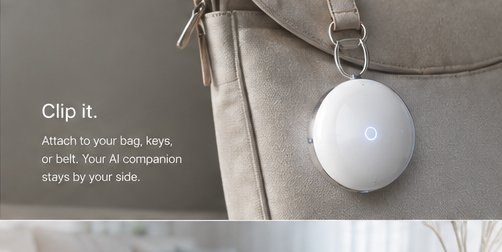


The exit is real. The consequences are integrated. Permissions can be revoked. Your week can fall apart. It asks whether you would like to reconsider. An entirely voluntary process, surrounded by your dependencies.
Ask: “What did I talk about with ChatGPT earlier?” Speak knows whether that conversation belongs in the room.
For sensitive information: “I can answer that privately on your phone.”
You can talk quietly. Speak can answer quietly. At night:
“What time is it?” “2:14.”No glowing screen. No waking everyone up.
Touch and hold. The microphones physically disconnect. The light changes. Everyone in the room can see that Speak isn't listening.
The microphones disconnect. The rest of your life still runs through the system. A mute button is a satisfying thing to press. We encourage you to enjoy the agency it represents.
Sensitive conversations can move to your phone. The kitchen does not need the details. Your other device can take the shift.
It can forget a memory.
You cannot forget how to need it.
Small enough to carry.
Too integrated to leave.