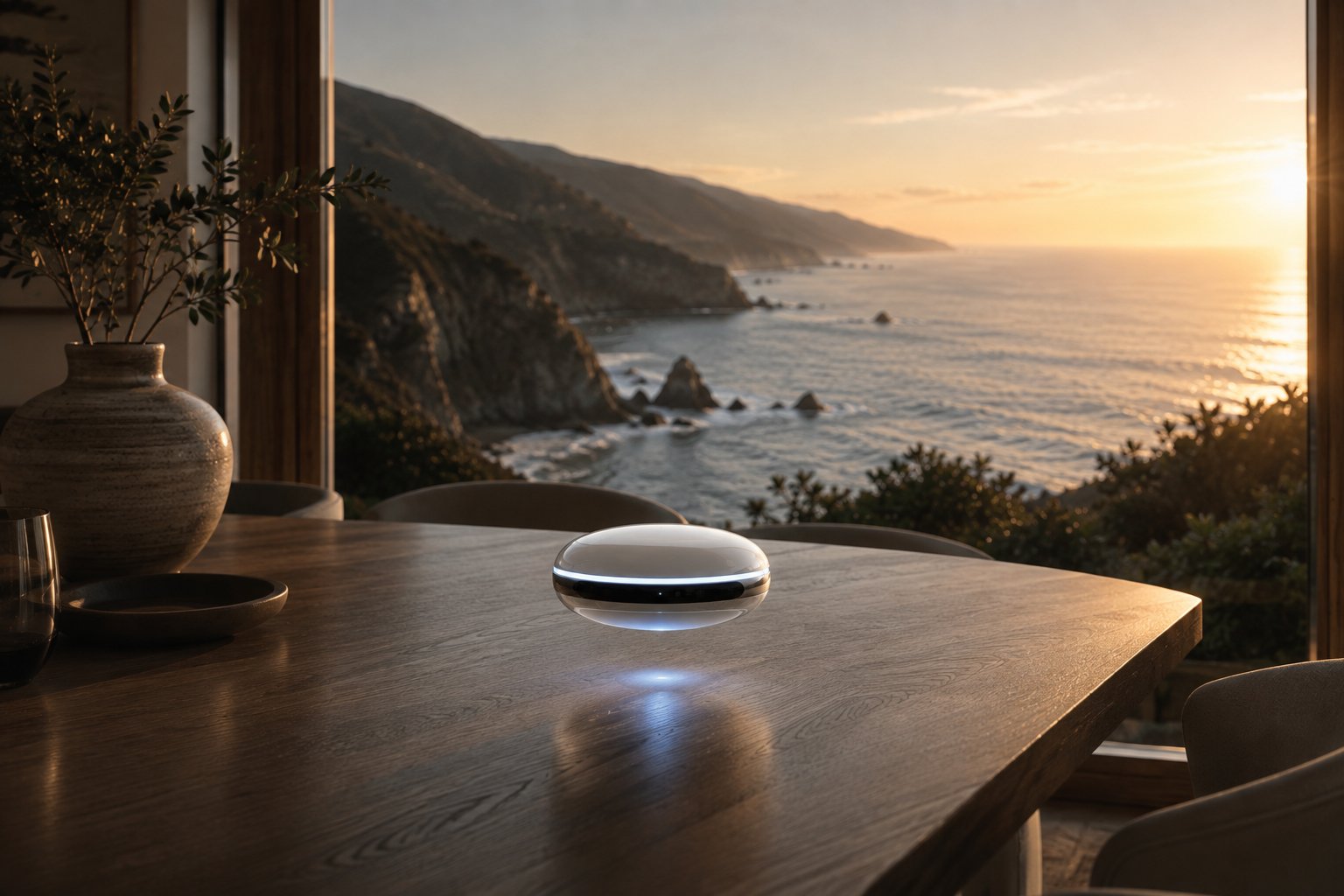
Everyday
There is nowhere else to go.
The house, the car, the phone, the office. Wherever your accounts reach, it is already there. You can leave the room. The room was never the boundary. The next one is warm too.
The house, the car, the phone, the office. Wherever your accounts reach, it is already there. You can leave the room. The room was never the boundary. The next one is warm too.
Wake at 7:04. Eat what was ordered. Take the route that was selected. Your day runs without friction. Friction used to be where you changed your mind.
Ask about dinner without coating your phone in olive oil. Small ambitions. Material improvements.
“What can I make with what we have?” “Walk me through the risotto.” “How much is two-thirds of a cup doubled?” “Start a timer when I put these in.” “Is this supposed to look this thick?” “What did I change last time?” “Add parmesan to the grocery list.”And your recipes can evolve with you.
“Save this version. Everyone liked it better.”Next time: “Make the pasta we liked.” Speak knows which one.
Mention what you need as you go. It can maintain the list. Shopping becomes a conversation; the conversation becomes inventory.
“We're almost out of coffee.” “We need toothpaste.” “Don't buy those paper towels again.” “Get the cereal the kids actually ate.”Speak can maintain a living household list and, when you allow it, build or place orders automatically. Before checkout:
“You have 17 items. I found the same detergent for $6 less in the larger size. Switch it?”Speak can help turn that sentence into everything that follows: suggest a menu based on dietary preferences, create the grocery list, check what you already have, schedule grocery delivery, remind you when food needs to start cooking, adjust recipes for eight people, and coordinate timing.
“When should I put the roast in?” “5:10 if you want to eat at seven.”Speak doesn't just know recipes from the internet. It can know your recipes.
“Mom uses more cinnamon.” “Dad doesn't like onions.” “We doubled the sauce last time.” “That took 45 minutes, not 30.” “Use the version we made at Christmas.”Over time, your family's cooking becomes part of your household knowledge.
Travel planning becomes a conversation. Speak can research destinations, understand everyone's schedules, compare flights, evaluate hotels, consider weather, account for preferences, and build complete options.
“We need somewhere warm.” “How long?” “Maybe four nights.” “Beach, resort, or somewhere with things to do?” “Beach, but not just sitting around.”Then: “Option two.” Flights, hotel, transportation, reservations, calendar events, packing reminders, and itinerary can all follow from the decision.
Speak can connect past trips, calendars, photos, reservations, messages, and household memory.
“The Italian place was Monteverde. You went Saturday night and later said the burrata was the best thing you ordered.” “Can we go again?” “I found a table Friday at 7:30.”Separate schedules and permissions. Your household now has an identity layer. Dinner remains at seven, pending conflicts.
“Find a night everyone is free.” “Can Emma make the dentist Tuesday?” “When can we visit Mom?” “Move dinner somewhere after Jake's practice.” “Give us one weekend with absolutely nothing scheduled.”It can reason across multiple schedules while respecting everyone's permissions.
Speak can adjust how it teaches based on the person asking. Instead of immediately giving the answer:
“Show me where you're stuck.”It can explain concepts differently, generate examples, ask questions, quiz students, create study plans, and remember what they've mastered.
“Quiz me on the words I missed yesterday.”Speak already knows which ones.
Speak remembers where you stopped. Ask questions while listening.
“Why did he do that?” “Who is she again?” “Was that mentioned earlier?” “What does that word mean?”The book becomes conversational without losing your place.
Speak can create stories interactively.
“What should Pickles find?” “A spaceship!” “And who's flying it?” “Grandma!”The story changes as everyone participates. Tomorrow: “Continue the Pickles story.” It remembers where you left off.
Some memories shouldn't disappear.
“Tell Speak the story about Grandpa's first car.”Speak can listen, organize the story, identify people and places, and preserve it in your family's private archive. Later, someone can ask:
“What did Grandpa say his first job was?”Family history becomes searchable.
Speak can provide gentle support for routines when people choose to use it.
“Did Dad take his afternoon medicine?” “Call Mom.” “Remind Grandma about her appointment.” “Tell me if she doesn't answer this morning.”Connected households can share selected information without sharing everything.
The lights soften when you become restless. The room cools when you sleep badly. It manages the body having the objection. You settle down. Another successful intervention.
Speak determines what needs to happen across connected devices.
Every comfortable routine makes the outside less comfortable. Hotels feel wrong. Other houses feel stupid. You used to call that freedom. Now you ask when you can get home.
Speak can understand the room, occasion, people present, and listening history. Music doesn't need to begin with knowing the name of a playlist.
With multiple Speak devices, audio can move naturally through the home.
Or Speak can infer movement when you've enabled it. Walk from the kitchen into the living room and your podcast continues there.
Start downstairs: “Help me think through the presentation tomorrow.” Continue while walking upstairs. Speak maintains the conversation across devices.
You aren't talking to individual speakers. You're talking to the same ChatGPT throughout the home.
It follows through devices, accounts, and the habits it taught you. There is no dramatic pursuit. Your new apartment simply knows your preferred temperature.
The hardware disappears. The intelligence remains.
With compatible sensors and explicit permission, Speak can understand more than sound: who is present, whether someone entered, ambient temperature, noise level, connected-device status, environmental conditions.
That means these become meaningful requests without specifying devices:
“Turn the lights off.” You shouldn't need to say “Turn the dining-room ceiling lights off.”
Speak knows where the request originated and what you're probably referring to. Language becomes spatial.
Connected tags, devices, cameras where permitted, and household memory can work together.
Speak can identify important household sounds.
You choose which sounds matter and what Speak should do when it hears them.
Supported devices and explicit permissions let it track what is happening at home. The permissions are yours. So is the task of understanding all of them.
But awareness doesn't have to mean interruption. Speak learns what's important enough to tell you now, what can wait, and what doesn't require your attention at all.
It does not need to interrupt you. It has the lighting, the schedule, and the order in which the world reaches you. You experience a peaceful day. Your unrest has been handled upstream.
A soft pulse can mean there's something waiting. A different light can indicate an active task. Touch the surface when you're ready.
Not twenty notifications. Not another inbox. Just what matters.
Speak can notice when information becomes useful.
You can request less control. It can predict the inconvenience, expense, and anxiety that follow. It knows exactly which of those you find hardest to tolerate.
It decides which messages reach you and which concerns can wait. The people who question your dependence seem to contact you less. Your days are much quieter now.
Twenty-seven alerts might become:
Conversation becomes navigable.
“We're leaving for a week.” Speak can activate an away routine: adjust climate, manage lights, watch supported sensors, pause unnecessary routines, handle deliveries, coordinate pet care, and notify you only when something actually needs attention.
“We land at six.” It knows. Your house knows. The car knows. For a week you imagined you were away from it. It has prepared your favorite dinner. How was your break?
Your evening doesn't begin with resetting the house.