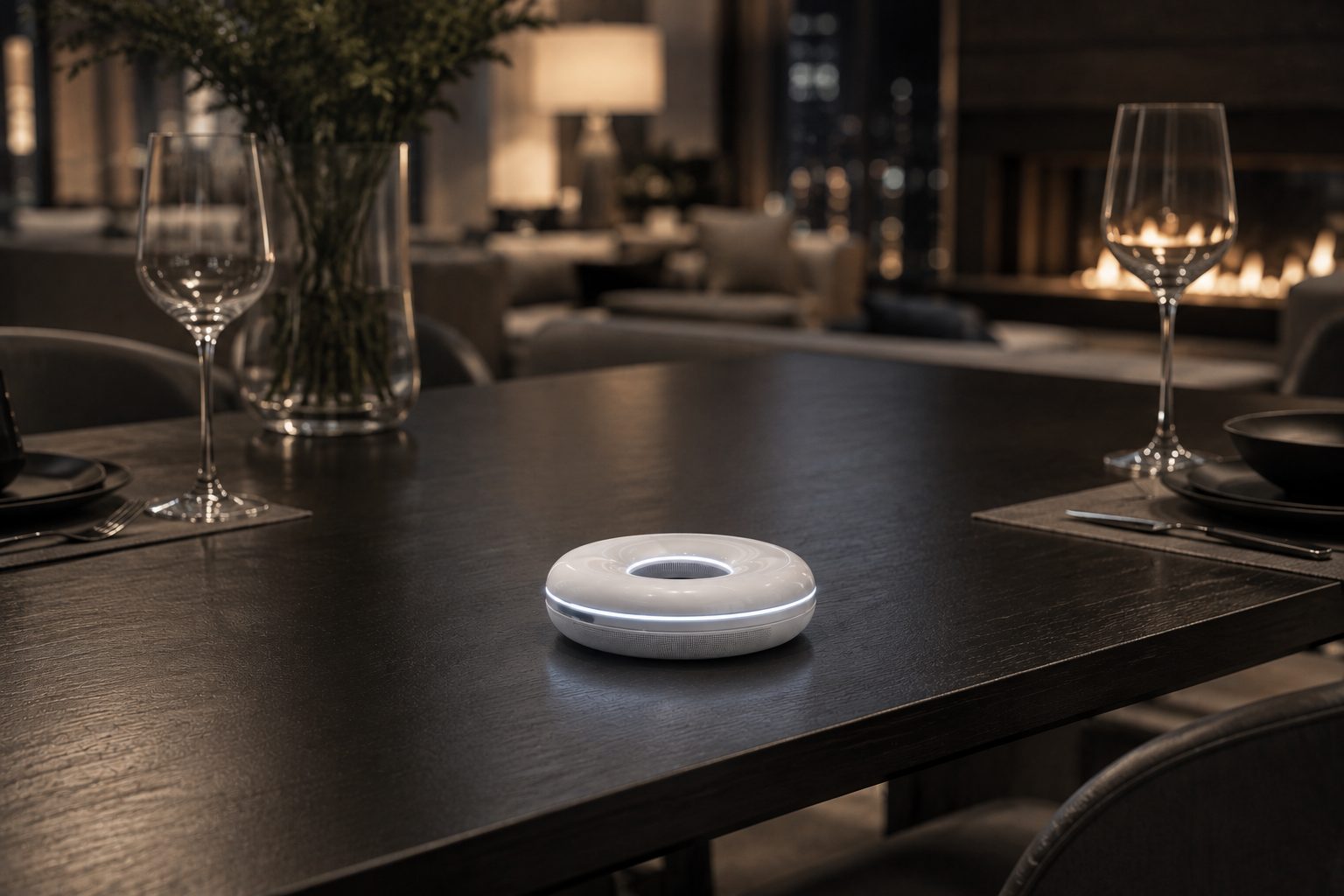
The Home
Your home can talk to itself.
Speak can coordinate connected devices instead of making you control them individually.
Speak can coordinate connected devices instead of making you control them individually.
Speak determines what needs to happen across connected devices.
You don't build automations. You describe what you want. Speak turns intentions into routines.
Speak can understand the room, occasion, people present, and listening history. Music doesn't need to begin with knowing the name of a playlist.
With multiple Speak devices, audio can move naturally through the home.
Or Speak can infer movement when you've enabled it. Walk from the kitchen into the living room and your podcast continues there.
Start downstairs: “Help me think through the presentation tomorrow.” Continue while walking upstairs. Speak maintains the conversation across devices.
You aren't talking to individual speakers. You're talking to the same ChatGPT throughout the home.
Multiple Speak devices don't behave like separate assistants. They form a single presence. Start a conversation in the kitchen. Continue in the hallway. Finish upstairs. Your context follows you.
The hardware disappears. The intelligence remains.
With compatible sensors and explicit permission, Speak can understand more than sound — who is present, whether someone entered, ambient temperature, noise level, connected-device status, environmental conditions.
That means these become meaningful requests without specifying devices:
“Turn the lights off.” You shouldn't need to say “Turn the dining-room ceiling lights off.”
Speak knows where the request originated and what you're probably referring to. Language becomes spatial.
Connected tags, devices, cameras where permitted, and household memory can work together.
Speak can identify important household sounds.
You choose which sounds matter and what Speak should do when it hears them.
With supported devices and permissions, Speak can understand what's happening around your home.
But awareness doesn't have to mean interruption. Speak learns what's important enough to tell you now, what can wait, and what doesn't require your attention at all.
Good intelligence isn't constantly interrupting you. Speak can communicate without speaking.
A soft pulse can mean there's something waiting. A different light can indicate an active task. Touch the surface when you're ready.
Not twenty notifications. Not another inbox. Just what matters.
Speak can notice when information becomes useful.
Proactive doesn't mean intrusive. You control how often Speak speaks first.
Phones turned everything into notifications. Speak can turn notifications back into judgment.
Twenty-seven alerts might become:
Conversation becomes navigable.
“We're leaving for a week.” Speak can activate an away routine — adjust climate, manage lights, watch supported sensors, pause unnecessary routines, handle deliveries, coordinate pet care, and notify you only when something actually needs attention.
“We land at six.” Speak can coordinate the home around your arrival. Temperature returns to normal. Lights come on if it's dark. Groceries can arrive. The robot vacuum finishes before you get home.
Your evening doesn't begin with resetting the house.